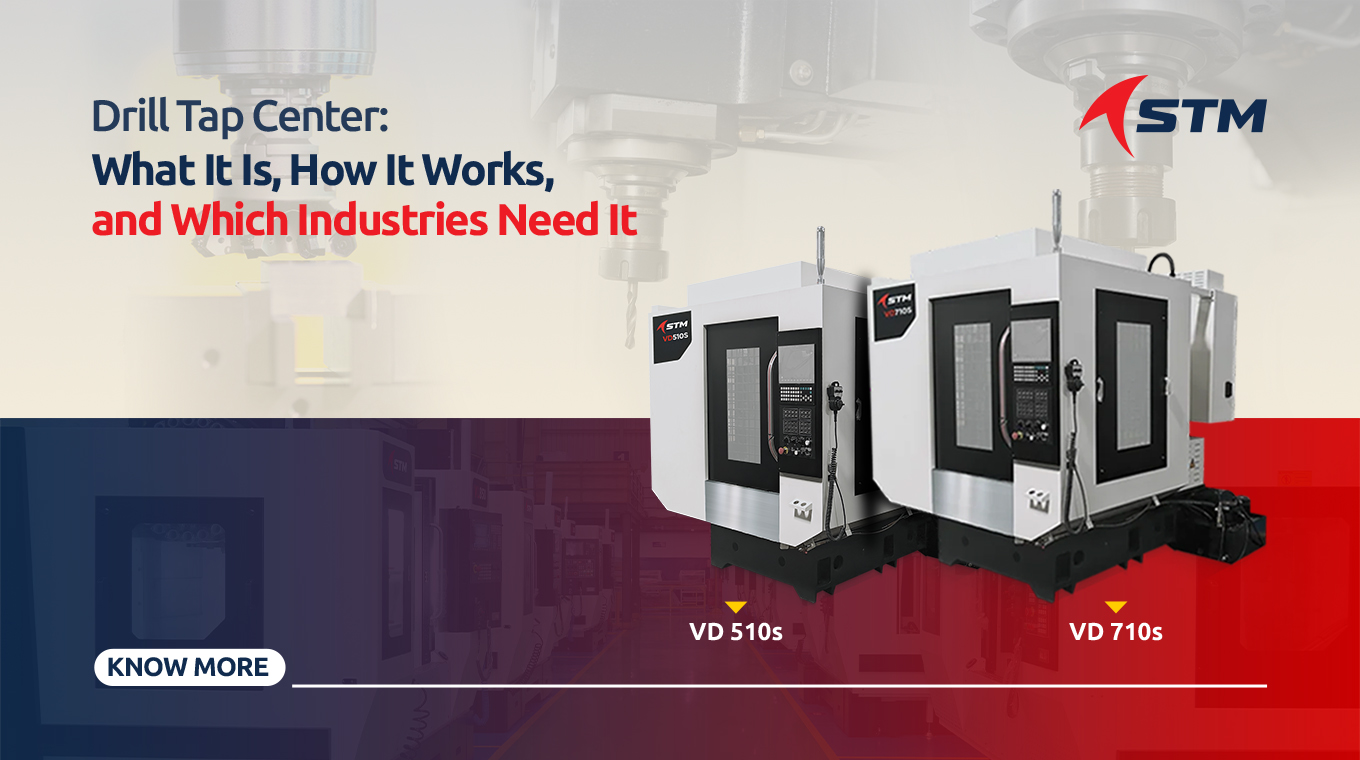
When a component requires multiple holes, tapped threads, and light milling operations, the challenge is not simply finding a machine that can perform them.
The bigger question is: Can these operations be completed efficiently, consistently, and with fewer interruptions?
For manufacturers producing repetitive components, factors such as cycle time, tool changes, setups, production volume, and floor-space utilization can directly affect productivity.
This is where a Drill Tap Center, a compact machining center designed for high-speed drilling, tapping, and light milling, can be a practical solution.
What Is a Drill Tap Center?
A Drill Tap Center is a CNC machine optimized for high-speed drilling and tapping, along with light milling operations.
It is particularly suitable for small to medium-sized components that require multiple holes, threads, and repeated machining features.
Typical capabilities include:
- High-speed drilling
- Tapping
- Light milling
- Automatic tool changes
- CNC-controlled machining
- Repeatable production
Depending on the component and machine configuration, multiple operations can be completed within the same setup, reducing unnecessary handling between processes.
How Does a Drill Tap Center Work?
The CNC control manages tool movement, spindle speed, feed rate, machining sequences, and tool changes.
For example, a component may require drilling, tapping, chamfering, and light milling. The Automatic Tool Changer (ATC) selects the required tools according to the programmed sequence, allowing these operations to be completed efficiently.
This can help reduce tool-change time and improve consistency across repeated production.
However, actual performance depends on factors such as material, tooling, cutting parameters, machine configuration, and component geometry.
When Is a Drill Tap Center the Right Choice?
A Drill Tap Center can be a good fit when your manufacturing process involves:
Multiple drilling and tapping operations
Repeated holes and threaded features can be handled within a programmed machining cycle.
Short cycle-time requirements
High-speed machining and automatic tool changes can help reduce machining and non-cutting time, depending on the application.
Repetitive batch production
For components produced repeatedly, consistent machining and reduced manual intervention can improve production efficiency.
Fewer setups
Where the component allows it, completing multiple operations in one setup can reduce handling and setup-related variation.
Limited floor space
Its compact design can provide useful machining capability without the footprint of a larger machining center.
What Components Can Be Machined?
Drill Tap Centers are commonly considered for components such as:
- Automotive brackets and housings
- Electrical and electronic components
- Bicycle and EV components
- Plumbing and valve components
- General engineering parts
- Smaller tooling and die & mould components
The suitability depends on the component size, material, geometry, tolerances, machining operations, and production volume.
Drill Tap Center vs VMC: Which One Should You Choose?
A Drill Tap Center can be a strong choice when the job is dominated by high-speed drilling, tapping, light milling, repetitive production, and shorter cycle times.
A VMC may be more appropriate when the component requires heavier milling, larger machining envelopes, deep cavities, or extensive material removal.
So, the most important question is not “Which machine is better?”
It is:
“Which machine is better suited to my component and process?”
How to Choose the Right Drill Tap Center
Before selecting a machine, evaluate:
- Component size and required travels
- Workpiece material
- Drilling, tapping, and milling operations
- Production volume
- Target cycle time
- Spindle requirements
- Tool capacity
- Required machine configuration
The right machine should match the complete machining process, rather than being selected on a single specification.
Why Choose STM CNC Drill Tap Centers?
At STM CNC, machine selection starts with understanding the component, machining process, and production requirements.
STM CNC Drill Tap Centers support applications involving high-speed drilling, tapping, and light milling, offering manufacturers a compact machining center option for suitable production requirements.
With World-Class Engineering for Indian Manufacturing, STM CNC focuses on machining solutions aligned with the needs of Indian manufacturers.
Frequently Asked Questions
What is a Drill Tap Center used for?
It is primarily used for high-speed drilling and tapping, along with light milling operations on suitable components.
Can a Drill Tap Center perform milling?
Yes. Depending on the configuration, it can perform light milling operations such as face milling, slotting, pocketing, contouring, and chamfering.
Is a Drill Tap Center suitable for high-volume production?
It can be suitable for repetitive production where cycle time, tool-change efficiency, and consistent machining are important.
How do I choose the right Drill Tap Center?
Consider your component, material, machining operations, production volume, spindle requirements, tool capacity, and cycle-time target.
Looking for the Right Drill Tap Center?
Have a component that requires drilling, tapping, and light milling?
Share your machining requirements with STM CNC and explore the right compact machining center for your application.
Talk to STM CNC for a consultation or live machine demonstration.