For growing machine shops, improving production is not always about adding more machines. In many cases, the real opportunity lies in using the available manpower, floor space and machining time more efficiently.
Conventional milling machines continue to be useful for general machining, repair work and low-volume jobs. But when the requirement shifts towards repetitive production, relying on multiple conventional machines can increase operator dependency, occupy more shop-floor space and make it harder to maintain the same machining consistency from one component to another.
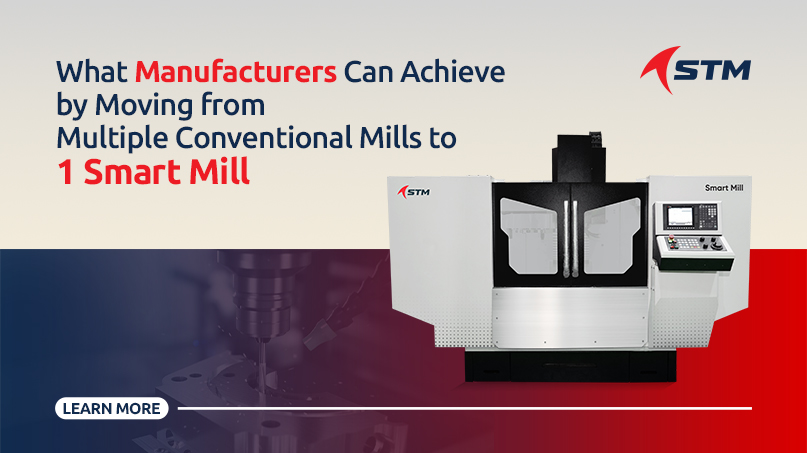
The STM Smart Mill offers a practical way to move towards CNC machining while improving productivity within the same manufacturing environment.
Moving from Manual Milling to Smarter CNC Machining
In conventional milling, the operator plays a continuous role throughout the machining process. Axis movements, positioning, feeds and repeated operations depend largely on manual control and operator experience.
Smart Mill changes this by bringing 3-axis CNC-controlled machining into the process. Once the machining operation is set, repetitive movements can be carried out in a controlled sequence with less continuous manual intervention.
This becomes particularly valuable for batch production, where the same machining operations need to be performed repeatedly. Instead of relying on the operator to manually reproduce every step, Smart Mill helps maintain a more consistent machining process from component to component.
For workshops transitioning from conventional machining, Smart Mill also simplifies CNC operation without bringing the usual complexity of working extensively with G-codes and M-codes, making the move towards CNC more approachable.
Smart Mill vs Conventional Milling Machine
The difference becomes clearer when both approaches are compared from a production perspective.
|
Comparison Area |
Conventional Milling Machine |
STM Smart Mill |
|
Operator involvement |
Requires continuous operator involvement |
Reduced continuous operator intervention |
|
Repeat machining |
Repeated operations depend on manual control |
CNC-controlled repeat operations |
|
Cycle time |
More dependent on operator handling |
Faster and more controlled machining cycle |
|
Machining consistency |
Can vary with operator skill and handling |
Better consistency across repetitive jobs |
|
Precision & Productivity |
Precision and output depend more on operator skill and manual handling |
Consistent precision with higher productivity through CNC-controlled machining |
|
Floor space |
More space required as machine count increases |
Better utilization of available shop-floor space |
|
Operation |
Primarily manual machining |
Simplified CNC operation without G-code and M-code complexity |
These differences become increasingly important as batch sizes grow and production requirements become more demanding.
3 Conventional Mills vs 1 Smart Mill
Consider a workshop using three conventional milling machines primarily to handle repetitive machining work.
Increasing production through this setup generally means managing three machines, three operators and a larger amount of floor space. The overall output also remains closely connected to individual operator speed, skill and consistency.
For suitable repetitive milling applications, one Smart Mill can consolidate work that may otherwise be distributed across three conventional milling machines.
Instead of continuously operating multiple machines manually, a single operator can manage CNC-controlled machining with reduced intervention. Faster cycle times, consistent accuracy and better utilization of production resources can help the workshop achieve more output without simply increasing the number of machines.
The advantage therefore goes beyond reducing machine count. It is about improving the productivity generated from manpower, floor space and machining time.
A Smarter Step Towards CNC Manufacturing
Moving from conventional milling to CNC does not necessarily mean making an immediate jump to a full-scale Vertical Machining Centre.
For workshops looking to improve repetitive production, reduce manual dependency and achieve more consistent machining, the STM Smart Mill provides a practical CNC upgrade.
Rather than relying on more conventional machines to increase capacity, manufacturers can take a smarter approach - fewer machines, better resource utilization, consistent machining and higher productivity from the shop floor.
Contact STM for the upgradation