
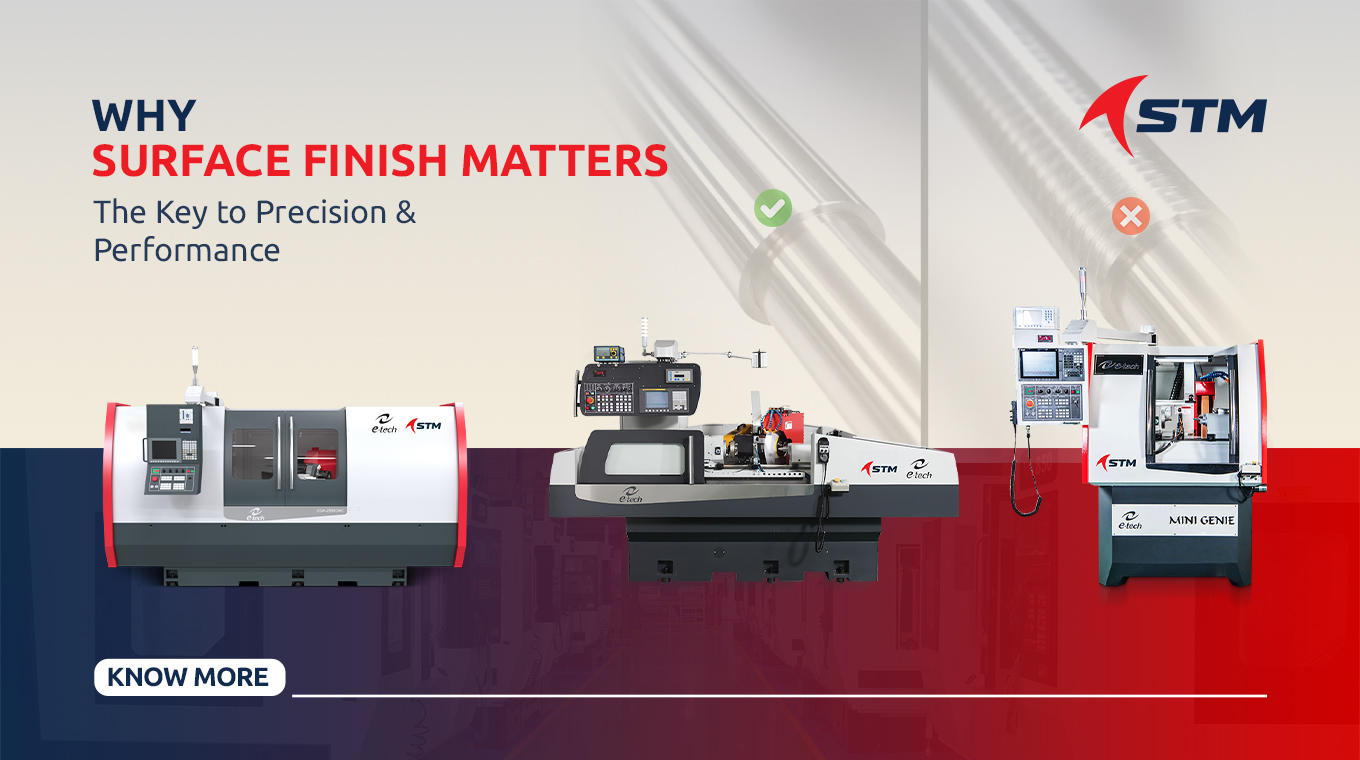
Surface finish is one of the most important quality indicators in precision manufacturing. Even when a component meets its required dimensions, poor surface quality can lead to premature wear, friction, sealing issues, and reduced product life. This is why manufacturers place significant importance on achieving the right surface finish during the grinding process.
In cylindrical grinding machine, surface finish is more than just appearance - it's a critical factor that influences the performance, reliability, and lifespan of precision-engineered components.
What is Surface Finish?
Surface finish refers to the texture and smoothness of a machined surface after the manufacturing process is complete. It is commonly measured using surface roughness (Ra), which indicates the average height of microscopic peaks and valleys on the workpiece.
A lower Ra value generally indicates a smoother surface, making it suitable for applications requiring high precision and minimal friction.
Why is Surface Finish Important?
The quality of a surface directly affects how a component performs in real-world applications.
Key Benefits of a Good Surface Finish
- Reduces friction between moving parts
- Improves wear resistance
- Extends component service life
- Enhances sealing performance
- Improves dimensional consistency
- Reduces maintenance requirements
A well-finished component performs more efficiently and delivers greater long-term reliability.
Factors That Affect Surface Finish
Several machining factors influence the final surface quality of a ground component.
-
Grinding Wheel Condition
A properly dressed grinding wheel produces a smoother and more consistent finish.
-
Machine Stability
Rigid machine construction minimizes vibration and helps maintain surface accuracy.
-
Grinding Parameters
Wheel speed, feed rate, and depth of cut must be optimized to achieve the desired finish.
-
Coolant Application
Proper coolant reduces heat generation, prevents surface burns, and improves grinding quality.
-
Workpiece Material
Different materials require specific grinding wheels and machining parameters to produce the best surface finish.
Applications Where Surface Finish is Critical
Many industries rely on precision ground components with excellent surface quality.
Common applications include:
- Automotive shafts and transmission parts
- Hydraulic cylinders and piston rods
- Bearing journals
- Aerospace components
- Machine tool spindles
- Precision tooling and moulds
For these applications, even small surface imperfections can affect product performance and operational reliability.
How STM Supports Precision Surface Finishing
At STM, our CNC cylindrical grinding machines are designed to deliver exceptional surface finish alongside high dimensional accuracy. With rigid machine construction, precision engineering, and stable grinding performance, STM enables manufacturers to produce components that meet demanding quality standards across a wide range of industrial applications.
Frequently Asked Questions
What is surface finish in grinding?
Surface finish refers to the smoothness and texture of a component after the grinding process is completed.
Why is surface finish important?
A better surface finish reduces friction, improves wear resistance, enhances sealing performance, and increases component life.
What affects surface finish during grinding?
Grinding wheel condition, machine rigidity, machining parameters, coolant application, and workpiece material all influence the final surface quality.
How is surface finish measured?
Surface finish is commonly measured using Ra (Surface Roughness Average), which indicates the average roughness of the machined surface.